REVOLUTIONIZING SEED PRODUCTION AND AGRICULTURAL PRODUCTIVITY
26TH JULY 2025
In recent years, the ‘Rooted Apical Cutting (RAC)’ technology has emerged as a game-changing innovation in the seed production landscape—particularly in vegetatively propagated crops like potatoes. At the intersection of biotechnology and sustainable agriculture, RAC is not only increasing the availability of quality planting materials but also redefining the economics of crop production for smallholder farmers across Africa and beyond.

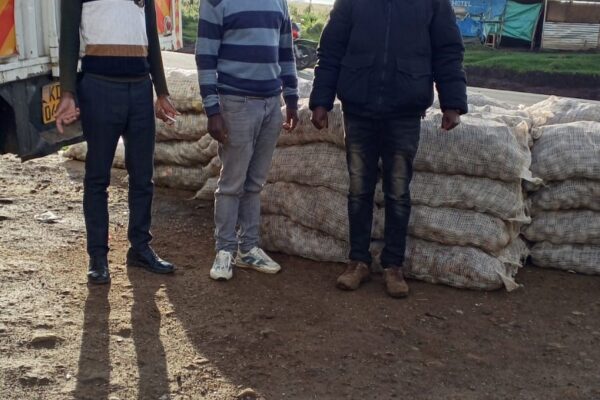
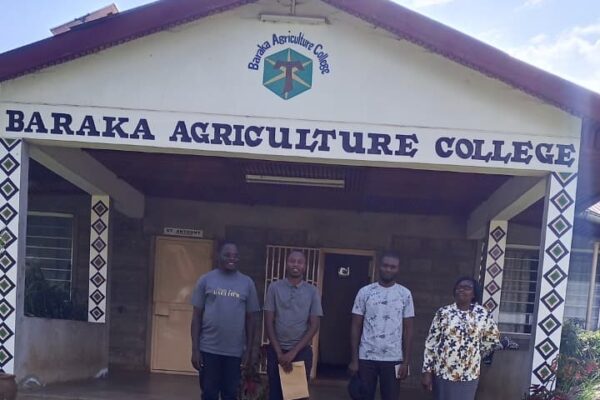
AGRA, NPCK and KALRO team members at one of the RAC private producer under KSPI project in Nyandarua county.
What is RAC?
Rooted Apical Cuttings are produced from tissue culture-derived mother plants in screenhouses or greenhouses. Unlike traditional seed tubers, RACs are clonal cuttings, each genetically identical to the parent plant and free of viruses and other systemic pathogens. These cuttings are rooted in a sterile media and can be transplanted directly into the field as seed starters.
How it Works
- Tissue Culture Initiation -Disease-free mother plants are generated via tissue culture in lab conditions. These plants are genetically pure and free from viruses.
- Screenhouse Propagation -The apical portions (top growth tips) of these plants are harvested and rooted under controlled conditions, creating rooted apical cuttings.
- Field Transplanting RACs are hardened and transplanted into the field to produce the first generation of seed tubers, commonly referred to as Generation 0 (G0) or Generation 1 (G1) depending on national standards.
RAC’s Role in Revolutionizing Seed Production
- Rapid Multiplication and Timely Availability
Traditional seed systems rely on multiple seasons to produce certified seed. RAC, on the other hand, offers a rapid multiplication cycle, shortening the time required to generate clean and or certified seed potatoes.
- Improved Seed Quality
RACs are:
– Pathogen-free (especially viruses and bacterial wilt)
– Genetically uniform and true-to-type
– Produced under controlled, hygienic conditions, minimizing contamination
This ensures farmers receive high-quality foundation seed, leading to better crop establishment and uniform growth.
- Cost Efficiency
Compared to tissue culture tubers and imported seed, RACs are:
– Cheaper to produce
– Require less storage space
– Easier to transport due to their lightweight nature
This cost-efficiency makes high-quality planting material more accessible, especially to smallholder farmers.
RAC’s Impact on Farmers and Food Security
*Increased Yield Per Unit Area -RAC-derived seed can produce 25–40 tonnes per hectare , compared to 8–15 tonnes from recycled, farmer-saved seed.
* Reduction in Seed Degeneration -Seed degeneration—a gradual loss of yield potential due to disease build-up—is significantly slowed with RAC-based systems, enabling longer seed renewal cycles and sustained productivity.
* Enhanced Farmer Profitability
– Farmers benefit from better-quality produce with uniform size and skin finish, attracting higher market prices.
– Lower input costs for seed result in improved net returns .
Countries like Kenya, Uganda, Rwanda, Nigeria, and Ethiopia have integrated RACs into national seed systems, often with support from development partners like NPCK, CIP, KALRO , AGRA , and KEPHIS in Kenya.

NPCK, ASARECA and KALRO team donating RAC to Blessed unity SHG in Murungaru, Kinangop, Nyandarua County.
Private seed producers and cooperatives are investing in screenhouses and decentralized RAC production , creating employment and enhancing local seed sovereignty.
NPCK through the KSPI (Kenya Sustainable Potato Initiative have been carrying several activities to boost RAC adoption including;
– Public-private partnerships to expand RAC access e.g ASARECA, FIPs, KALRO
– Continued farmer training and extension support
– Subsidies or credit for screenhouse infrastructure
Rooted Apical Cuttings are not just a new propagation technique—they are a paradigm shift in how we think about seed quality, multiplication, and delivery.
For smallholder farmers, RAC is more than a technology—it’s a pathway to higher yields, better livelihoods, and a more resilient agricultural future
MANUAL PACKAGING OF ROOTED APICAL CUTTINGS AND OBSERVATIONS
Apical cuttings have become an increasingly preferred method in potato propagation due to their ability to produce clean, disease-free planting material with high vigor. To ensure their viability during storage and transport, proper handling and packaging practices are essential. This article outlines the standard procedure for handling apical cuttings learned from Rukalias farm and observations made over a four-day storage period
Selection and Preparation
The process starts with the selection of healthy, disease-free mother plants. Apical cuttings are taken from the terminal parts of the stems—regions known for their active growth and strong rooting potential. Each cutting is trimmed to a length of 10–15 cm, ensuring uniformity and suitability for transplanting.
Manual Packaging Procedure
Box Selection: Strong, cartoon boxes are used to protect the cuttings from external pressure and damage during transportation
Inner Lining: Each box is lined with polythene paper. This is crucial in retaining moisture and maintaining a humid environment, both of which are necessary to preserve the health of the cuttings.
Packing Method: The cuttings are arranged carefully within the boxes, ensuring they do not touch each other. This minimizes the risk of bruising and fungal rot. Once arranged, the boxes are securely sealed to protect the contents from external contamination and moisture loss
Observations Over Time
Days 1–2:
The cuttings maintained a healthy, vibrant green color—an indication of good health and successful adaptation to the packed environment. No signs of wilting or browning were observed, confirming effective moisture retention by the polythene lining
Days 3–4:
By the third and fourth days, a yellowish discoloration began to appear, possibly due to physiological stress. This change may result from prolonged storage, reduced oxygen supply, or nutrient depletion within the cuttings.

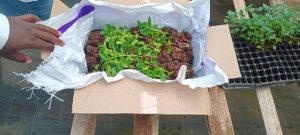
observation after 3-4 days
manual packaging