Potatoes are the most important food and cash crops globally, and the second most important after maize in Kenya. Potato production is often threatened by pests and diseases, despite its importance as a source of food security and income generation for millions of farmers.
Potato cyst nematodes (PCN) are a major pest of potatoes that originated from the South American Andes, where they coevolved with their preferred host, the potato. They have, however, spread globally across the continents of South America, North America, Europe, Asia, Oceania, and Africa. Two major species, golden PCN, Globodera rostochiensis, and white PCN, Globodera pallidaa can devastate potato production, reducing the yields to 80% if left unmanaged. There are no effective control measures for PCN due to their biology and ability to form survival structures (cysts) in the absence of their hosts. In Kenya, the golden potato cyst nematode (Globodera rostochiensis) was first reported in 2014 in Nyandarua County and has since spread to other potato-growing counties like Laikipia, Meru, among others. Potato cyst nematode is a regulated pest in Kenya, where infested fields cannot be used to grow certified seed potatoes.
How do Potato Cyst Nematodes infect?
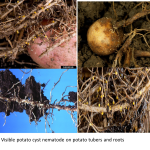 Potato cyst nematodes are microscopic roundworms that attack the roots of potato plants. The juveniles, after hatching, invade the roots where they feed and cause swellings. Later, the female nematodes develop into cysts filled with hundreds of eggs and remain in the soil long after the potato crop has been harvested, awaiting the preferred host. These cysts are highly resilient and can stay dormant for 20–30 years without the host.
Host Plants for PCN
PCN exclusively infects plants in the Solanaceae family, with key hosts such as potatoes, tomatoes, and eggplants (aubergine). They also attack other solanaceous weeds such as blackberry nightshade and some weeds like Datura, Hyoscyamus, Lycopersicon, Physalis, Physoclaina, Salpiglossis, and Saracha allow reproduction of PCN. The root exudates from these host plants trigger the juveniles to hatch and invade the roots of the plant.
Signs and symptoms of PCN
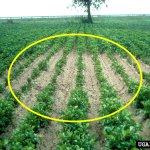
Potato field affected by golden potato cyst nematode (G. rostochiensis) (Credit © Bonsak Hammeraas NIBIO)
Potato cyst nematode (PCN) infested plants have poor growth, are smaller and stunted, show premature aging or yellowing, and wilt more easily in dry spells. Small round cysts (about 0.5 mm) can be seen on the surface of the roots, appearing white, yellow, or golden in colour for immature Globodera rostochiensis. The infested crop also has reduced yield as a result of reduced potato tuber sizes and the number of tubers per plant. However, under severe infestation, the plants decay and die.
It is important to note that symptoms of PCN in an infested crop can be confused with other pathogen infections or nutritional deficiencies; thus the need to confirm PCN infestation via soil analysis in the laboratory.
Spread of PCN
PCN can be spread through the movement of infested plant material, such as seed potatoes, seedlings, and mature plants. Being a soil-borne pest, it can be spread from one farm to the other through contaminated soil, water, wind, or any items that have been in contact with infested soil, such as clothing, footwear, farm equipment, animals, and livestock.
Implications of PCN:
PCN has great implications in potato farming. They cause severe yield losses and reduce the quality of tubers, affecting their marketability. Once the soil is infested, it is easily spread to other areas and becomes difficult to eradicate. Since PCN is a quarantine pest, it restricts trade between countries, and infested fields are barred from producing certified seed potatoes. PCN has a long-term impact on the farm because the cysts remain viable in the soil for 20-30 years.
Management of PCN
1. Prevent introductions: For countries where PCN has not been introduced, strict phytosanitary and quarantine regulations must be adhered to. Even for countries where PCN is present, all imports must be cleared by the NPPO (KEPHIS) to ensure freedom from PCN.
2. Avoidance. This is a strategy where the introduction of PCN in clean fields is avoided by:
-
- Using certified seeds free from nematode infestation
- Practicing strict hygiene, where farm machinery, tools, and footwear are cleaned when moving from one farm to the other.
- Movement of soil and water from infested areas to clean areas should be avoided.
- Ensure regular monitoring and scouting of fields and regular testing of soil for the presence of nematodes.
3. For farms already infested by PCN, effective management can reduce the damage and spread through
-
- Crop Rotation: Rotate potatoes with non-host crops (e.g., maize, beans, barley, wheat, or brassicas) for 4–6 years. This starves the nematodes and reduces their population in the soil.
- Use of Resistant Varieties: Planting resistant varieties such as Sherekea, Taurus, and Manitou, which help limit nematode multiplication.
- Soil Management: Improving soil fertility and organic matter will help strengthen potato plants, making them less vulnerable to nematode damage. Also, soil solarization (using plastic sheets to heat soil under the sun) can help suppress nematode populations in small-scale settings.
- Use of Biological and Chemical Controls: Biocontrol agents such as Paecilomyces lilacinus (a parasitic fungus) and Bacillus species can help suppress PCN. There are also Nematicides that exist, but they are costly, environmentally risky, and often unavailable to smallholder farmers. However, guidance and caution must be taken when using them.
- Quarantine and Certification: Strict regulatory measures will help the potato industry by ensuring that PCN-infested fields do not produce seed potatoes.
Conclusion
Potato cyst nematodes pose one of the greatest hidden threats to potato farming worldwide. Therefore, there is a need for urgent awareness creation to all stakeholders in the potato industry and to come up with an integrated sustainable management strategy.
To ensure the pest population is below the economic threshold levels, there is a need to adopt and integrate measures such as the use of certified seed potatoes, observe farm hygiene, crop rotation, use resistant varieties, biological options, good agronomic practices, and continuous surveillance and monitoring.
Finally, collaboration between farmers, policymakers, regulators, researchers, and other stakeholders is critical in order to safeguard the potato industry and ensure food security and livelihoods remain resilient against this silent but powerful pest.