- Potatoes are heavy-feeding crops that extract large quantities of nutrients from the soil during growth and tuber bulking. Among the essential nutrients, nitrogen (N), phosphorus (P), and potassium (K), commonly referred to as NPK are the most important for achieving high potato yields and producing large, high quality tubers, and ensure a healthy plant growth.
- Each nutrient plays a distinct but complementary role: nitrogen drives canopy development, phosphorus supports strong roots and tuber initiation, and potassium enhances tuber filling, quality, and resilience. However, these benefits are only realized when nutrients are applied in correct amounts and balance—something that can only be achieved through routine soil testing before planting. By basing fertilizer decisions on soil test results, farmers can improve yields, reduce losses, save money, and maintain sustainable potato production for the long term.
- According to the IFDC/AGRA (2018) report, one hectare of potatoes removes approximately 233 kg of N, 30 to 50 kg of P2O5, 284 kg of K2O, 48 kg CaO, 35 kg MgO, 40 kg S, 0.23 kg Zn, 0.19 kg B, 0.10 kg Cu, 0.21 kg Mn, and 3.10 kg Fe. Therefore, there is need to enough potato crop gets enough of each nutrient in sufficient amounts for higher yields.

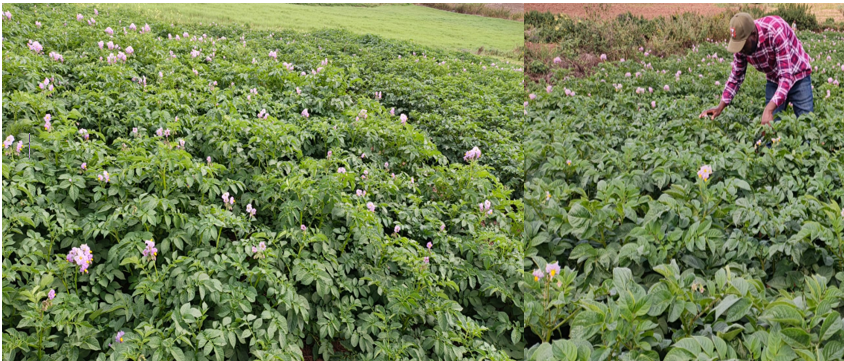
Fig 1. Healthy potato crop in the field
- Nitrogen (N): The Engine of Vegetative Growth
Why nitrogen matters in potatoes
- Nitrogen plays a key role in leaf, branch and stem development. It gives the crop a vigorous leafy canopy which captures more sunlight and manufactures the carbohydrates that later fill tubers, increasing the final yield.
- As an important component of chlorophyll, amino acids and other plant building blocks, nitrogen is necessary for greening and photosynthesis to take place. It should be applied at the recommended rates and at the right time according to the soil laboratory analysis report. Otherwise, high levels of nitrogen cause a lush canopy, which provides a micro-climate that leads to increased susceptibility of the crop to blight infection, crop has few and small tubers, delayed maturity and poor skin set in tubers reducing storage quality.
- Nitrogen deficiency manifest as pale green or chlorotic. The leaves turn yellow, brown and necrotic starting from the lower older leaves to the younger leaves. Short supply of nitrogen also causes the plants to have an erect stunted growth with reduced leaf sizes. N deficiency causes the root system to show deep roots but with low biomass and density. In severe cases, the stem and petiole may develop purple or reddish tints becoming thin and weak.

Fig 2. (a) Yellowing symptoms of nitrogen deficiency on old leaves and pale green young leaves; (b) pale green colouration and stunted plant growth.Photo: Kumar
Risk factors that can lead to N deficiency
- Leaching:depending on the type of soil, amount of rainfall or irrigation type, nitrogen can be washed away and be unavailable to the plant.
- Low Organic Matter:Soils with little organic matter struggle to retain nitrogen.
- High pH/Low pH: Soil pH can affect nitrogen availability.
- Fast Growth:Rapidly growing crops demand high nitrogen.
Management & Prevention
- Organic Matter:Incorporate well-decomposed compost or manure.
- Fertilizers:Use balanced fertilizers (e.g., 7-7-7 or higher K for tubers) or nitrogen-rich ones like urea, ammonium nitrate.
- Split Applications:Apply nitrogen in stages, especially before tuber set and during early bloom, often guided by petiole analysis.
- Cover Crops:Research suggests cover crops can help manage nitrogen.
- Phosphorus (P): Root Strength and Early Tuber Initiation
Why phosphorus is essential for potatoes
- Phosphorus is an essential element in every metabolic process. It is required during early plant growth for proper root establishment, early and uniform tuber initiation, it improves tuber shape, dry matter content and tuber maturity.
- It plays a key role in photosynthesis, energy production, transfer of sugars synthesized within the plant (Adenosine Tri-Phosphate (ATP), storage in tubers and in the inter conversion to sugars and starch. A good phosphate nutrition is beneficial for the formation of thick and resistant skin on tubers as well as for starch quality (viscosity).
- For a healthy crop, both nitrogen (N) and Phosphorous (P) complement each other. Whereas N facilitates the trapping of energy from sunlight, P permits the utilization of this energy. Secondly, N is a major component of plant protein, while P regulates the protein synthesis.
- Phosphorus deficiency results in poor root development, delayed tuber formation, reduced number of tuber per plant and a stunted, purple coloration on the edges of the leaves as an accumulation of unutilized sugars not transported to the storage site in the tubers. In addition, the leaf blades cup upward at the margins while the shoots are thin, upright and the lower stems may darken.

Fig 3. (a) Purple colouration of the leaf edges (b)Poor root development and reduced number of tubers in in P deficient crop (Photo:Yara)
Risk factors that can lead to P deficiency
- Environmental stress: Low temperatures caused by cold and wet soils or drought conditions slow phosphorous movement in soil.
- High pH/Low pH: Acidic, very alkaline or high iron soils bind phosphorus making it unavailable.
- Root system: potatoes have limited root sysem and hilling further restricts phosphorous uptake
- Low soil phosphorus: insufficient P in the soil may lead to deficiency especially if its immobile.
Management & Prevention
- Fertilizer placement: Apply phosphorus fertilizers at or before planting near the seed because P moves slowly. In cold soils, phosphorus becomes less available, making placement (banding) important.
- Soil Amendments: Improve soil health through application of organic matter to enhance P availability
- Soil testing: test the soil regularly to understand P levels and identify fixation issues.
- Potassium (K): The Quality and Disease-Resilience Nutrient.
- Potassium is an essential element for transfer of leaf sugars to the tubers, and conversion of sugars into starch, improving tuber dry matter. It also regulates osmotic potential of cells and water balance, and supports nitrate reduction within the plant.
- Potatoes require potassium in large quantities throughout the growing season, with the highest demand during tuber initiation, bulking, and maturation. Compared to other crops, potatoes have a higher K requirement accumulating up to 16 kg K/ha/day at peak growth
- Adequate potassium in potatoes helps improve tuber sizes, yield, and quality, enhances resistance to diseases, pests, drought, and cold stress and reduces internal bruising as well as black spot damage during harvesting and handling.
- Conversely, potassium deficiency in potatoes is manifested first on older leaves as chlorosis at the leaf margins progressing inward. The leaves become deformed, deep-veined, dark green with a shiny, metallic or “bronzed” appearance causing poor growth, stunted growth and weak plants.
-
- Low soil potassium reserves
- Sandy soils with poor nutrient-holding capacity
- Over-irrigation, causing K to leach below the root zone
- Acidic soils (pH < 5.0), increases K mobility and loss
- Water stress (drought or uneven moisture) leads to limited K uptake.
- Excessive application of Calcium (Ca), Magnesium (Mg) and Ammonium-based fertilizers (NH₄⁺) compete with potassium for root uptake
- Use of high-yielding varieties with greater nutrient demandn tubers, the symptoms appear as reduced tuber sizes, quality and reduced yield. The dry matter content become low, black or dark spots near the vascular ring appear and leads to increased susceptibility to mechanical damage (internal bruising), storage rots and diseases.

Fig 4. Older leaves showing chlorosis at the leaf margins progressing inwards as a result of potassium deficiency.
Risk factors that can lead to Potassium Deficiency
Management and Prevention
1. Fertilizer Management
Apply base potassium application based on the soil test results by applying potassium-rich fertilizers (Muriate of potash (MOP), Sulphate of potash (SOP)), especially where quality is critical. In addition, employ split potassium application by applying basal application at planting and top dressing at hilling/earthing up in order to meet peak demand.
2. Soil and Water Management
Maintain optimal soil pH through liming where soils are acidic, avoid over-irrigation, especially in sandy soils and ensure there is consistent soil moisture to support nutrient uptake.
3. Integrated Nutrient Management
Incorporate organic manure to improve soil structure and nutrient retention, balance potassium with nitrogen, calcium, and magnesium applications and monitor crops regularly for early deficiency symptoms.
- Soil Testing, an important practice before planting
Application of fertilizers blindly without soil analysis often leads to imbalanced nutrition, nutrient wastage, poor yields, or even soil degradation.
Soil testing is the foundation of smart potato nutrition management as it:
- a) Determines current nutrient levels (N, P, K and others)
Knowing whether the soil has low, adequate, or high levels helps tailor fertilizer amounts to meet crop needs.
- b) Saves money and prevents over-fertilization
Farmers avoid buying unnecessary fertilizers, which in turn reduce production costs.
- c) Prevents nutrient deficiencies or toxicities
Proper nutrient balance improves yield, tuber quality, and plant health.
- d) Helps correct soil pH
Potatoes grow best at pH 5.5–6.5.
Soil tests identify whether lime or sulfur is needed for pH adjustment.- e) Improves fertilizer efficiency
Soil testing guides in ensuring the right nutrient is applied at the right rate, right time, and in the right place.
- f) Supports sustainable soil management
By avoiding nutrient depletion or long-term soil damage, soil health and fertility are maintained for future seasons.
How soil testing should guide fertilizer use in Potatoes
- Take soil samples 0–20 cm deep before planting following the standard operating procedure for soil sampling.
- Pack the soil samples in the correct sample bags, label correctly and submit them to an accredited lab.
- Use lab recommendations to choose the appropriate fertilizer type and the rate.
- Use split nitrogen application, one part at planting and the other part during earthing-up.
- Ensure phosphorus is banded near the seed for early uptake.
- Apply potassium early enough to support tuber bulking to ensure efficient nutrient uptake.