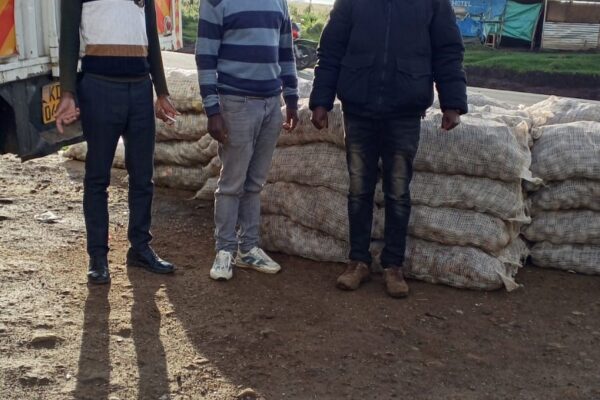
Kenyan potato belts are typically cool, high-elevation regions (e.g. Nakuru, Meru, Nyeri, Marakwet) with ample rain. Night time temperatures are low enough to favor potato tuber bulking – for example, Marakwet’s “very cold” climate is ideal for potatoes. However, R. solanacearum thrives in warm, moist soils and poorly drained fields. Infections rapidly spread during rainy seasons or irrigation if waterlogging occurs. The pathogen can survive deep in soil (even >1 m depth) and on plant debris. Water-saturated soil and heavy run-off favor spread (bacteria wash into drains or onto adjacent fields). Thus well-drained fields and avoidance of waterlogging are critical. In contrast, extended dry periods and cold winters tend to reduce pathogen survival.Figure: Example of potato fields in the Kenyan highlands (Narok County). Smallholder farmers typically devote 20–30% of their land to potato (often intercropped or in rotation), as shown here. Farms are generally small (average <2.4 ha), so long crop rotations are difficult. In this context, maintaining clean seed and rigorous sanitation is essential to prevent soil build-up of the wilt pathogen.
Among the best ways of controlling Bacteria Wilt is, Integrated Disease Management (IDM) Approach
Because Ralstonia is so difficult to eradicate, the consensus of Kenyan researchers is that no single method will control potato wilt. Instead, an integrated approach combining all effective measures is essential. In practice, Kenyan integrated management of potato wilt involves:
- Host resistance: Use the best available resistant or tolerant varieties (Kenya Karibu, Sifa, etc.) to reduce epidemic build-up.
- Clean seed: Start each season with the healthiest possible seed (certified or positively selected).
- Field hygiene: Enforce strict sanitation – disinfect tools, remove volunteers, uproot and destroy wilted plants.
- Crop rotation and diversification: Rotate potatoes with non-host crops according to the guidelines above.
- Environmental management: Avoid risk conditions (waterlogging, heavy mulch that prevents drainage), and maintain good soil fertility to keep plants vigorous.
- Continuous monitoring: Scout fields regularly; early detection and action can prevent large outbreaks.
This IDM philosophy is echoed in Kenyan extension materials:
“Management of bacterial wilt calls for an integrated approach. Plant resistance is an important component… [And] for better results use highly resistant varieties coupled with disease-free tubers and clean fields.”
In other words, combine every available tool.

Potato crops affected by bacterial wilt |Courtesy of African Farm Resource Centre

Potatoes affected by bacterial wilt |Photo Courtesy CIP