Stakeholders from across CEHA focus Countries (Kenya, Uganda, Tanzania, Ethiopia, and Rwanda) gathered at the Golden Tulip Hotel in Nairobi for the COMESA-EAC Horticulture Accelerator (CEHA) Regional Workshop on the Elimination of Institutional and Regulatory Frameworks Addressing Non-Tariff Barriers (NTBs) in Agriculture, held from June 19–20, 2025. The high-level forum brought together government officials, trade experts, private sector actors, and development partners to chart practical solutions to unlock cross-border trade in key agricultural commodities such as horticultural produce, staples, and inputs. The workshop served as a platform for accelerating progress on harmonizing trade standards, promoting regional integration, and strengthening food systems across the COMESA region.
In remarks delivered on her behalf by Caroline Chore, Senior Trade Development Officer at the Ministry of Industry, Principal Secretary for Trade Regina Ombam called for urgent and coordinated action to address persistent NTBs that continue to stifle horticultural trade across borders. She emphasised the importance of fostering cooperation among National and regional stakeholders to create a harmonised trade environment that allows farmers and agribusinesses to thrive. Her sentiments were echoed by Trade and Industry PS Dr. Juma Mukhwana, who noted that NTBs remain a major obstacle to regional trade, agricultural productivity, and economic development. “The horticulture sector is a key driver of economic development, supporting farmers, SMEs, and agribusinesses across COMESA and EAC member states,” said Mukhwana. “However, persistent NTBs continue to limit market access and the seamless movement of horticultural products.”
The CEHA workshop focused on identifying and mapping NTBs affecting the sector, fostering dialogue between policymakers and producers, and building capacity for compliance with trade facilitation protocols and sanitary and phytosanitary (SPS) standards. Critical topics discussed included SPS harmonisation, institutional reforms, and the introduction of digital traceability systems to streamline trade in perishable agricultural products.
A key outcome of the workshop was the drafting and adoption of a joint communiqué and action matrix, which outlines priority interventions, time-bound commitments, and stakeholder roles in the elimination of NTBs across the region. The communiqué reaffirmed the collective commitment of COMESA and EAC member states to dismantle trade barriers, harmonise SPS measures, and support regional value chain growth. The action matrix serves as a practical roadmap for implementation, with clear milestones for reviewing regulatory frameworks, aligning input standards, digitising trade procedures, and supporting capacity building.
Dr. John Mukuka, CEO of the Alliance for Commodity Trade in Eastern and Southern Africa (ACTESA), underscored the adverse impact of NTBs on regional trade, describing them as “hidden forces that delay trucks, inflate costs, and erode farmers’ incomes.” He cited statistics indicating that intra-COMESA exports dropped by 11 per cent in 2020, from Sh1.4 trillion (USD 10.9 billion) to Sh1.25 trillion (USD 9.7 billion), with NTBs being a major contributing factor. Across the East African Community (EAC), 256 NTBs were reported, and while 95 percent had been resolved by mid-2022, traders continue to face significant delays, spending anywhere from 2 to 296 hours on compliance processes. Mukuka noted that even a 10 per cent increase in paperwork time could reduce exports by an equivalent margin.
The ACTESA CEO stressed the need for harmonised SPS standards and the removal of NTBs, especially for high-value horticultural products like avocados, Irish potatoes, and onions. “These are perishable products. Any delay due to NTBs or SPS issues risks losses, and this must be addressed urgently,” he said. He added that harmonisation efforts are currently focusing on seed and input requirements, pest and disease control protocols, and the regulation of approved agricultural chemicals, with the process expected to be completed within the next six to twelve months. Such reforms, he noted, will protect both farmers and consumers while enhancing profitability across the fruit and vegetable value chains.

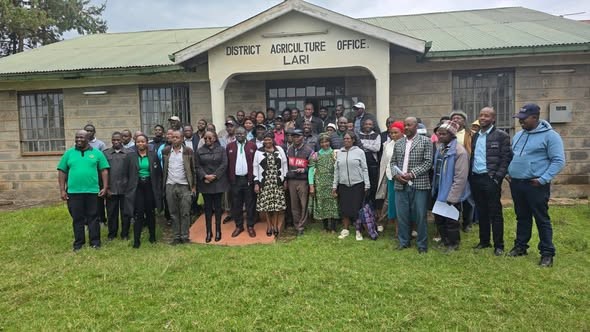
| Stakeholders pose for a photo led by CEO of ACTESA Dr. John Mukuka sited center |
Looking ahead, Mukuka emphasised that intra-regional trade must be strengthened before targeting international markets such as the EU and China. “Our regional trade currently stands at just 10 to 15 per cent, compared to over 50 percent among EU member states. We must strengthen trade within Africa first before tapping into global markets,” he said.
The workshop concluded with strong calls to action for National governments to prioritise NTB audits and reforms, for private sector actors to document and share real-time challenges, and for regional bodies and development partners to support the implementation of the joint action matrix. With a renewed sense of urgency and clear commitments outlined in the joint communiqué, stakeholders left Nairobi energised to fast-track reforms that will unlock the region’s agricultural potential, improve livelihoods, and foster deeper regional economic integration.