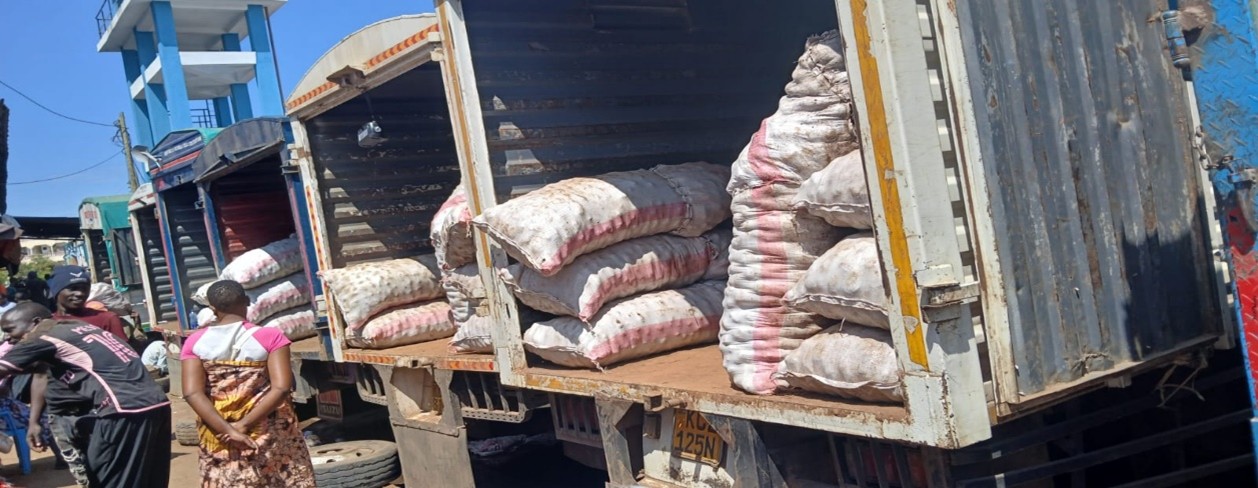
Potatoes are a vital staple in Kenya, not just on the plate, but across the agricultural economy. Recently, NPCK embarked on a focused tour of two key potato markets that is Kiambu and Mombasa markets to understand the market in terms of sourcing, packaging and sales of ware potatoes. Though vastly different in geography and scale, both markets offered unique insights into the dynamics of the potato supply chain from sourcing and packaging to distribution and the daily rhythms of trade.
The first Market to visit was the Mombasa, Kenya’s coastal trade and logistics hub. For three days, we observed a high-volume market that acts as a major consumer endpoint for potatoes grown in the Rift Valley. On average, 9 to 14 lorries arrive daily at the Mombasa market, primarily ferrying potatoes from Nakuru County and Narok counties. This volume reflects both the demand from hotels, restaurants, and households, as well as Mombasa’s growing urban population. The supply chain is long and logistically intense requiring efficient coordination across counties.
One of the most notable aspects was the variation in packaging. Potatoes here are commonly packed in large 95kg bags, although there is also a significant presence of medium-weight bags ranging between 70 to 80kg especially form Narok. This inconsistency not only complicates pricing but also opens room for unfair trade practices — especially where standardized weighing is absent. Despite the bustle, the market faces several challenges. Limited cold storage facilities mean that quick turnover is essential. Any delays, especially due to transport issues lead to losses for traders and farmers and creates a partial shortage that may affect the prices.
The next market visited was the Kiambu Market located just outside Nairobi yet worlds apart from the intensity of Mombasa.On average, the market receives about 3 lorries daily, mainly supplying potatoes from the Nyandarua County. The supply here is more measured and tends to serve local vendors, restaurants, and nearby urban centers. Additionally, other than the Lorries getting to the major Market, there are other traders that opt to get their produce direct form the farm to the retailers through door-to-door marketing. This helps in reaching consumers in the villages easily. Compared to Mombasa, Kiambu market felt more grounded, with stronger ties between traders and suppliers. However, like many other local markets in Kenya, it still lacks proper weighing systems, structured packaging, and value-added services like sorting or grading.
Opportunities and Gaps
These two markets represent different ends of the same supply chain, Mombasa as a mass-distribution endpoint, and Kiambu as a mid-level consumer and redistribution point. Several key observations stood out during my visits:
-
- Packaging Variation: The lack of standardization in bag weights (70–95kg) complicates pricing transparency and can disadvantage farmers and buyers.
- Supply Sources: Mombasa’s dependence on Nakuru versus Kiambu’s on Nyandarua shows how regional specializations shape trade routes.
- Volume Disparity: Mombasa handles far larger volumes, indicating greater risk of post-harvest loss if logistics or storage systems fail.
- Market Systems: Both markets could benefit from digital platforms, standardized weighing, and better access to price information.

Ware potato market in Mombasa, Kongowea