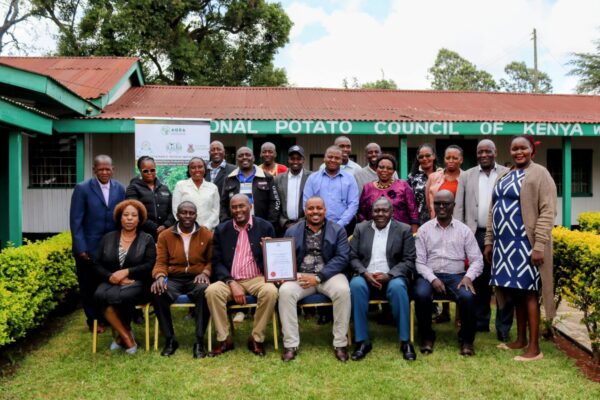
 On 14 May 2026, the National Potato Council of Kenya (NPCK) hosted a high-level delegation from the Namibian Agronomic Board (NAB) at its offices in Nairobi, marking an important step towards strengthening collaboration between Kenya and Namibia in the development of the potato sector.
The Namibian Agronomic Board is a government agency mandated to regulate and develop the crop sector in Namibia. The delegation comprised senior leadership from the institution, including Dr. Fidelis Mwazi, Chief Executive Officer; Mr. Gilbert Mulonda, General Manager for Agronomy and Horticulture; and Ms. Maria Immanuel, Senior Trade Advisor.
The visit provided an opportunity for both organizations to explore potential areas of partnership aimed at accelerating the growth and sustainability of Namibia’s emerging potato industry. Discussions focused on several strategic areas of collaboration, including potato seed research and development, establishment of variety trials, seed potato system development, stakeholder capacity building through training and exposure visits, technology and innovation transfer, as well as strengthening quality control and food safety assurance systems.
The delegation also expressed interest in learning more about the upcoming 13th World Potato Congress (WPC 2026), which Kenya will host in Naivasha from 26–30 October 2026. Discussions highlighted opportunities for Namibian stakeholders to participate in the congress and benefit from global knowledge exchange, networking, and exposure to innovations shaping the potato industry worldwide.
During the engagement, participants gained valuable insights into the evolution of potato production in Namibia. Unlike many African countries where potato farming has a long history, commercial potato production in Namibia is relatively new. The first recorded potato crop was planted in 2011 by a large-scale farmer, marking the beginning of the country’s potato industry.
Over the years, production has largely been dominated by commercial-scale farmers, with smallholder farmers only beginning to venture into potato cultivation in 2024. Despite the sector’s relatively short history, potato productivity in Namibia is reported to be impressive, with yields exceeding 40 tonnes per hectare under commercial production systems.
However, the sector continues to face several challenges, particularly for emerging smallholder farmers. Limited access to certified seed potato and the high cost of production remain significant barriers to expansion and productivity. These challenges have created a strong case for collaboration and knowledge exchange between Namibia and Kenya, which has decades of experience in potato production, seed systems development, farmer organization, and value chain coordination.
The discussions underscored the importance of regional cooperation in addressing common challenges facing the potato sector across Africa. Through partnerships, countries can share experiences, technologies, innovations, and best practices that contribute to more resilient and competitive potato value chains.
NPCK welcomed the opportunity to engage with the Namibian Agronomic Board and expressed its commitment to supporting initiatives that promote sustainable potato sector development across the continent. The proposed collaboration is expected to provide a platform for mutual learning, allowing both countries to share experiences and explore solutions that enhance productivity, seed quality, market access, and farmer livelihoods.
NPCK appreciates the NAB delegation for taking time to visit the Council while attending the Nairobi Summit and looks forward to building a strong and productive partnership that will contribute to the growth of the potato industry in both Kenya and Namibia.